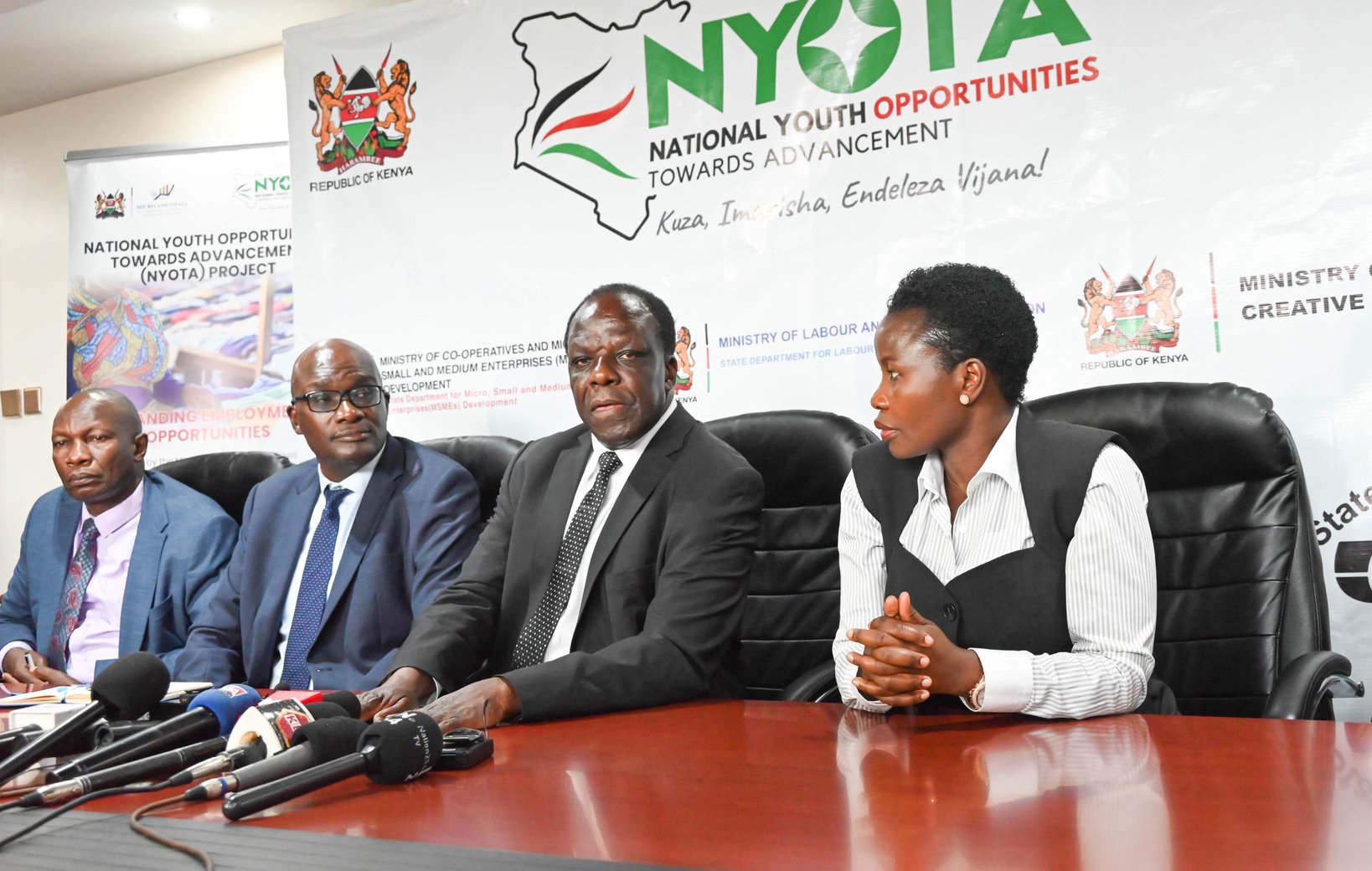
An Infotrak poll conducted in January 2026 shows most Kenyans are aware of the Nyota Fund, but opinions differ on its fairness, transparency and impact.
While many welcome the initiative, concerns persist over eligibility clarity, grant adequacy and regional access disparities.
The nationwide survey was conducted by Infotrak Research and Consulting using a representative sample of 800 respondents drawn from all 47 counties.
The Nyota Fund is a government-backed youth enterprise programme introduced as part of Kenya’s broader efforts to tackle youth unemployment and expand access to startup capital for young entrepreneurs.
The fund was launched in 2024, following sustained public debate about the limited reach of earlier youth financing schemes and the growing difficulty young people faced in accessing affordable credit.
Policymakers framed the Nyota Fund as a simplified, grant-based intervention designed to reduce barriers such as collateral requirements and complex loan application processes.
It was created to support young Kenyans aged 18 to 34, particularly those with vocational skills, digital talents, or small business ideas but limited financial resources.
Unlike revolving loan funds, the programme offers a Sh50,000 startup grant, positioning it as seed capital intended to help beneficiaries launch or formalise micro-enterprises rather than take on debt.
The programme was also conceived as a response to concerns that many youth-targeted funds had become inaccessible or overly bureaucratic.
By using digital application systems and linking eligibility to basic education and national identification, the fund aimed to reach a wider segment of young people, including those outside the formal employment sector.
Since its rollout, the Nyota Fund has been implemented in phases, with government agencies overseeing verification, training and disbursement.
Authorities say the phased approach was meant to allow for system testing, monitoring and gradual scaling across all counties.
According to official briefings, tens of thousands of young Kenyans have so far benefited from the programme, either through direct grant disbursements or related training and onboarding processes.
However, the government has acknowledged that demand continues to outstrip available funding.
The poll applied stratified sampling to ensure proportional representation by region, gender, age, income level and employment status.
A sub-sample of 620 respondents answered detailed questions on awareness, eligibility, transparency and perceived impact of the Nyota Fund.
According to the poll, a clear majority of respondents said they had heard of the Nyota Fund, indicating that the programme has achieved wide national visibility within a short period.
Awareness levels were consistently high across regions, though marginally stronger among urban residents and younger respondents.
However, when respondents were asked what they understood to be the main purpose of the Nyota Fund, the results showed considerable variation.
Some associated the programme primarily with youth empowerment and entrepreneurship, while others viewed it as a general employment or financial assistance initiative.
The lack of a dominant interpretation suggests that while the programme is well known, its core objectives are not uniformly understood.
The Infotrak poll also examined public perceptions of eligibility criteria, including age and education requirements.
Most respondents described the criteria as fair in principle. Yet this confidence weakened when broken down by income and employment status.
Respondents from lower-income households and those outside formal employment were more likely to express doubts about whether the criteria are applied equitably in practice.
Regional differences were also evident. In counties with better access to administrative services, respondents were more likely to express confidence in the application process.
In contrast, participants from more remote areas reported concerns about barriers related to information access and verification requirements.
A key focus of the survey was the Nyota Fund’s Sh50,000 startup grant. When asked whether this amount was sufficient to start a business, respondents were divided.
Some said the grant could provide a meaningful foundation, particularly for small-scale or informal enterprises.
Others argued that rising costs make the amount inadequate for launching a sustainable venture.
Urban respondents were more likely to question the sufficiency of the grant, while those in lower-cost regions were comparatively more optimistic.
Younger respondents expressed slightly higher confidence in the grant’s potential than older participants, reflecting differing expectations about startup capital needs.
Transparency emerged as another area of mixed perception. While some respondents rated the application and selection process as clear, others said they found it difficult to understand how beneficiaries are chosen.
Lower transparency ratings were more common among respondents who also expressed scepticism about eligibility fairness and grant adequacy.
The poll further explored engagement levels. Only a minority of respondents said they had personally applied for the Nyota Fund or knew someone who had directly benefited.
This gap between awareness and participation suggests that knowledge of the programme has not yet translated into widespread uptake.
Infotrak’s methodology emphasised neutrality and descriptive analysis. The poll does not assess policy effectiveness or outcomes, but instead captures public sentiment at a specific moment in time.
The findings highlight a programme that has successfully entered public consciousness but still faces challenges in communicating its purpose and building trust across diverse communities.































Comments
Sign in with Google to comment, reply, and like comments.
Continue with Google